Rocket Play Field Notes
Rocket Play Mobile: Browser Experience and PWA
Rocket Play presents a responsive mobile browser product for iOS and Android and also has a branded Progressive Web App. Both belong to the web-based side of the casino’s technology, where a wide catalogue of pokies and live tables has to fit alongside account and support information on a comparatively small display. The format matters because a phone can change how rules, payment figures and navigation appear, while the underlying game and account conditions remain separate from the device used to view them.
The responsive browser experience
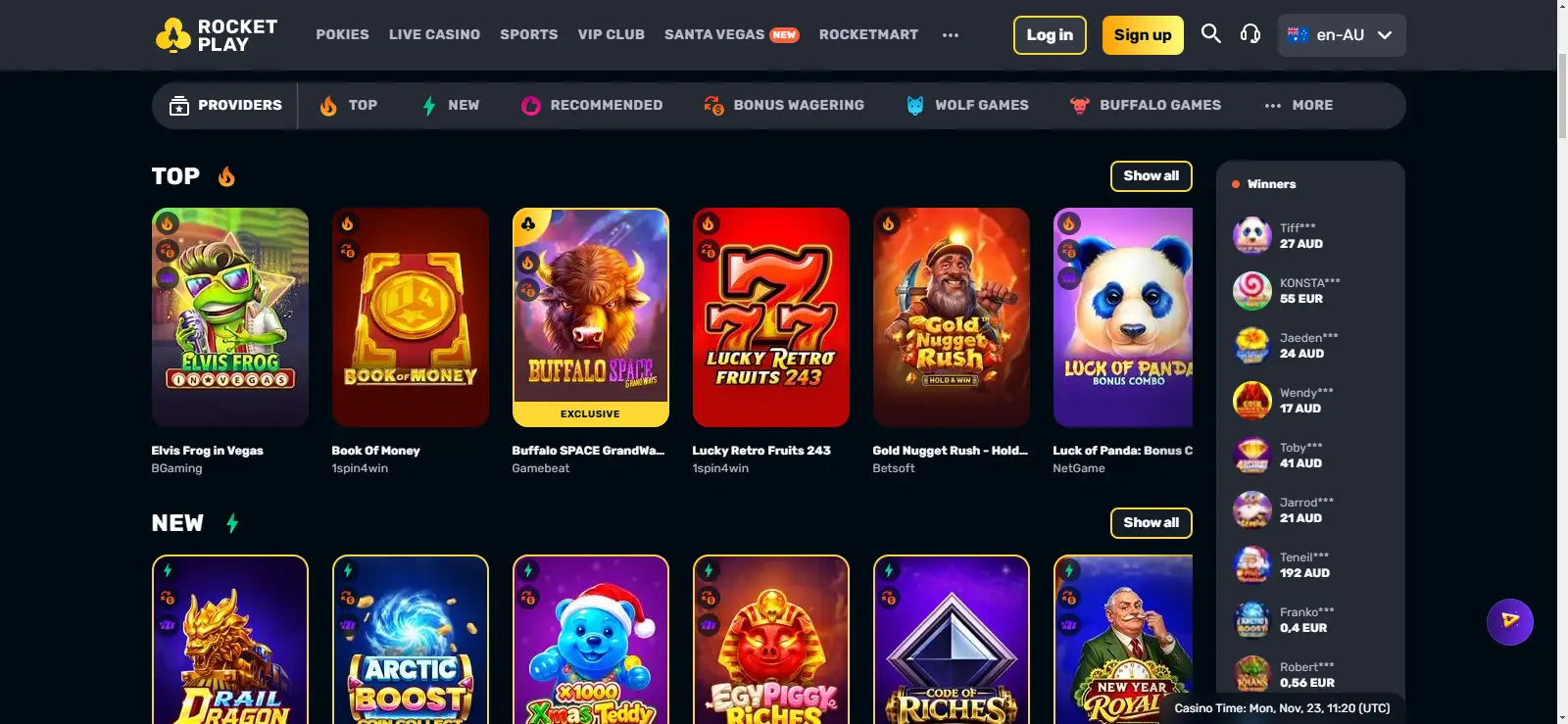
Rocket Play uses a responsive mobile website for iOS and Android, and its product material shows pokies, live games and support in the smaller-screen experience. The core format is a website rendered inside a mobile browser, so its layout can adapt to a phone’s viewport rather than requiring a wholly separate desktop interface. That distinction explains how game categories and account information can be presented through a single web-based product.
A responsive layout changes where controls appear as screen width decreases. Navigation that sits across a desktop header may become more compact, while several panels that can be viewed side by side on a larger screen may need to stack on a phone. A long menu can be harder to scan when the user sees only a small part of it at once. These are normal interface trade-offs, not proof that one platform has more games or a different set of account rules.
The mobile presentation matters particularly for live-dealer titles because game video, choice controls and information about a round all compete for visible space. A video stream can occupy a meaningful share of the display, leaving less room for on-screen descriptions of decisions or game conditions. In software pokies the layout often uses less continuous video space, but it still has to present stake information, results and feature controls legibly.
The practical difference is between content availability and visibility. The mobile catalogue may include the same broad groups, yet a narrow viewport makes it easier to overlook a secondary rule, payment detail or account notice. A label being physically present on a page does not mean it can be read simultaneously with the main game area. The pokies and live-studio breakdown explains why streamed tables, software games and crash formats demand different kinds of attention.
Payments and account prompts on a small screen
Rocket Play’s Australian-facing payments material distinguishes fiat deposit entries from bank and crypto withdrawal routes. On mobile, those distinctions can be visually compressed into menus or stacked fields. A payment-method label may tell only part of the story: direction of transfer, denomination, minimum, maximum and the identity of the holder are all separate considerations. In a constrained layout, the complete description may extend beyond the first visible screen.
For example, the platform’s Australian-facing table names Visa and Mastercard and Skrill for deposits, bank transfers for withdrawals, and BTC and ETH for deposits and withdrawals. A card deposit should therefore not be assumed to imply a card cashout route. Bitcoin and Ethereum balances also use cryptocurrency units rather than a fixed AUD equivalent. These properties of the product exist regardless of whether the reader sees the table on a large screen or a phone.
With a cryptocurrency transfer, address length and network selection create additional opportunities for misreading on a small display. The risks are general to blockchain transfers: a mistyped address or a transfer sent by an incompatible route may be irreversible. A truncated address can look convincing even when its beginning and end are different from those intended. A phone’s text prediction, clipboard contents or a line break can affect how a long string is perceived.
| Screen element | Why it deserves attention | Interpretation |
|---|---|---|
| Payment method | Deposit and withdrawal options may differ. | A method name alone is not a two-way payment promise. |
| Currency amount | AUD, BTC and ETH are not interchangeable units. | The number needs its currency label beside it. |
| Wallet address | Long strings may be visually truncated or hard to inspect. | Errors can make blockchain transfers irreversible. |
| Identity prompt | Supporting records may be requested during review. | A transfer limit does not complete an identity check. |
In the wider account process, a document request and a money-transfer field serve different functions. Identity evidence relates to account ownership, while an amount or route relates to payment processing. On small displays those elements can look like a single uninterrupted workflow, making it useful to interpret the underlying requirement separately. More detail on the limits and units appears in the AUD and crypto cashier overview.
Privacy and session controls
A phone is often both an authentication device and the device used to read account information. That combination has convenience benefits, but it can also expose sensitive material if the device is shared, left unlocked or used in a public place. Identity documents, payment details and support conversations are especially sensitive because a screenshot can capture data that a person might not intend to keep or share.
The brand’s terms envisage checks involving ID, address documents and payment ownership. Those requirements make a distinction between reading an ordinary games page and handling account records. An account screen can include names, documents, balances or transaction-related prompts that are absent from a catalogue view. A generic security practice is to treat these screens as personal financial information rather than as ordinary entertainment content.
- Device access: a device lock reduces casual viewing of open account pages and copied payment details.
- Session awareness: a browser tab can remain present after a user switches to another app; the visible screen is not the full measure of account state.
- Link scrutiny: lookalike pages and support messages can imitate routine account prompts, particularly on narrow screens.
- Document handling: photographs of identity records may carry more personal information than is visible in a thumbnail.
- Notification previews: account and payment messages may be exposed on a device’s lock screen depending on its settings.
These are general mobile privacy considerations rather than claims about special safeguards supplied by Rocket Play. A mobile browser or PWA runs inside the security model of the device and browser environment. It cannot, by itself, guarantee that an account holder’s credentials are protected, that a copied address is correct or that a third party cannot see a notification.
How a progressive web app differs from native software
Rocket Play has a branded Progressive Web App, or PWA, alongside its mobile browser experience. A PWA is a web application designed to take advantage of browser capabilities that can make it behave more like a standalone application in certain environments. Its underlying content and application logic remain web-based. This contrasts with a conventional native mobile app built against a phone operating system’s application framework.
The difference is technical, not a ranking of which interface is safer or better for gambling. Both types of presentation can display responsive content, support interactive controls and handle account forms. However, their distribution, update mechanisms and integration with the phone’s system differ in principle. A web application can deliver interface changes through web content, while native software normally packages code for a specific platform. Actual behaviour depends on the application and device.
| Aspect | Mobile browser view | PWA as a web-app format |
|---|---|---|
| Underlying technology | Website content in a browser tab. | Web technologies with optional app-like integration. |
| Navigation frame | Browser interface and tabs remain central. | Can appear in a more app-like window where supported. |
| Updates | Web content can change without a native app package. | Web-based content and logic can likewise change. |
| Device capabilities | Governed by browser and operating-system permissions. | Also governed by browser support, permissions and implementation. |
| Game availability | Depends on the product and title conditions. | The PWA label alone does not change those conditions. |
Live games, pokies and customer support on mobile
Rocket Play’s mobile-facing experience includes slot categories, live-dealer content and access to support. Live chat is described as available around the clock by both the brand and an independent casino review. A chat entry appearing near a game list does not make the underlying games similar: a fast software title and a streamed live table still involve different pace, screen usage and decision structures.
For Rocket Play the named live suppliers include Evolution and Playtech, while software categories also span pokies, jackpots and table games. The breadth is meaningful as an indication of different content formats, yet a studio name is not a shortcut to understanding a title’s volatility or the amount spent during repeated play. A live-table stream may present the dealer and controls together; a slot screen may devote more space to reels and features. The same screen size imposes different visibility costs in each case.
- Category level: broad navigation distinguishes pokies, table games and live studios.
- Game level: individual products have their own rules, stakes and outcome structures.
- Account level: document prompts, balance restrictions and support requests use information separate from game mechanics.
- Device level: screen size, text scaling and privacy controls change how much information is visible at once.
The most distinctive element of Rocket Play’s mobile presentation is the combination of a responsive browser product and a branded PWA around a large third-party catalogue. That offers two web-based ways to present the same broad product identity. It also creates familiar small-screen concerns: rules may sit behind navigation layers, transfer addresses can be difficult to inspect, and video competes with account information for attention.
Questions about mobile access
Does Rocket Play have a mobile browser experience?
Yes. Rocket Play presents a responsive mobile website for iOS and Android, including pokies, live games and support.
What is the Rocket Play PWA?
Rocket Play has a branded Progressive Web App, a web-based application format that can provide an app-like interface through supported browser technology.
Does a PWA change the casino account rules?
No. A PWA describes how web content is delivered; it does not change the underlying payment, identity and account conditions.
Which game categories are shown on mobile?
The mobile experience includes pokies and live-dealer content, with the broader catalogue covering table games and other software games.
Is live chat part of the mobile experience?
Yes. Rocket Play offers live chat, and the service is described as available 24/7; chat availability is separate from the resolution time of an account review.
Mobile access centres on web technology
Rocket Play’s mobile proposition is grounded in web delivery: a responsive browser experience on iOS and Android and a branded PWA. The format supports a catalogue that includes pokies and live-dealer games, plus account and support functions. The most important practical difference from desktop is how much navigation, game information and payment detail can be visible at once.
The PWA distinction is useful for understanding interface technology, but it does not imply additional game eligibility, special transfer conditions or reduced wagering risk. A clear reading of the mobile product separates its display format from account documentation, cryptocurrency transfer risks and the rules of each game. Those underlying considerations remain consequential on any screen.
Read next
Created by the ”Rocket Play” editorial team.